

Key Takeaways
Portfolio management is the process of selecting and managing investments to achieve your financial goals.
A well-diversified portfolio helps reduce risk while improving long-term returns.
Asset allocation is one of the most important factors affecting investment performance.
Regular portfolio reviews and rebalancing help keep investments aligned with your goals.
Successful investing is about discipline, patience, and consistency not timing the market.
Even beginners can build wealth by starting early and following a structured investment strategy.
Storytelling
Imagine two friends, Rohan and Aman, who both started working at the age of 25. Every month, they earned almost the same salary. Rohan invested consistently in different assets like mutual funds, stocks, bonds, and gold according to a proper plan. Aman, on the other hand, invested randomly whenever someone recommended a "hot stock." After 15 years, Rohan had built a sizeable investment portfolio that generated steady returns despite market ups and downs. Aman had earned profits occasionally but had also suffered significant losses because his investments lacked planning. The difference wasn't luck—it was portfolio management. A well-managed portfolio doesn't promise overnight riches, but it significantly improves the chances of creating long-term wealth while keeping risks under control.
"Successful investing isn't about finding the perfect investment. It's about building the right portfolio and staying invested for the long run."
Introduction
Many people believe investing simply means buying stocks and waiting for their prices to increase. In reality, investing is much more than selecting a few popular companies. The true secret behind long-term financial success lies in portfolio management.
Portfolio management is the art and science of selecting, organizing, monitoring, and adjusting different investments to achieve specific financial objectives. Instead of putting all your money into a single investment, portfolio management focuses on spreading investments across multiple asset classes to balance risk and return.
Whether your goal is buying a home, funding your children's education, planning retirement, or achieving financial freedom, having a properly managed investment portfolio can make a significant difference.
This guide explains portfolio management in simple language so that even a beginner can confidently start building wealth.
What is Portfolio Management?
Portfolio management is the process of choosing, organizing, monitoring, and adjusting various investments to achieve financial goals while managing investment risks.
A portfolio can include different assets such as stocks, mutual funds, bonds, exchange-traded funds (ETFs), gold, real estate, fixed deposits, and even cash. Instead of depending on a single investment, portfolio management combines multiple investments that work together to create better stability and long-term growth.
Good portfolio management involves understanding your financial goals, risk tolerance, investment horizon, and expected returns. It is not about buying the best-performing stock every year but about building a balanced collection of investments that can perform well under different market conditions.
The primary objective is to maximize returns without taking unnecessary risks.
Why is Portfolio Management Important?
Many investors lose money not because they choose poor investments, but because they fail to manage their portfolios properly.
Markets constantly change due to inflation, interest rates, government policies, economic growth, global events, and company performance. A portfolio that worked well five years ago may no longer be suitable today.
Portfolio management helps investors maintain balance. It ensures that investments remain aligned with changing financial goals and market conditions.
A well-managed portfolio offers several advantages. It reduces unnecessary risk through diversification, improves the chances of earning consistent long-term returns, helps investors avoid emotional decision-making during market volatility, and keeps investments aligned with life goals such as retirement planning, wealth creation, or purchasing property.
In simple words, portfolio management provides direction to your investments instead of leaving them to chance.
What Are the Different Types of Portfolio Management?
Portfolio management can generally be classified into different approaches based on an investor's objectives and level of involvement.
Active portfolio management involves regularly buying and selling investments in an attempt to outperform the market. Active managers conduct detailed research, monitor economic developments, analyze company performance, and make investment decisions based on changing market conditions. Although active management offers the potential for higher returns, it usually involves higher costs and greater risk.
Passive portfolio management, on the other hand, aims to match the performance of a market index rather than outperform it. Investors typically invest in index funds or ETFs that track benchmark indices. This strategy involves lower costs, less frequent trading, and long-term investing.
Another classification includes discretionary and non-discretionary portfolio management. In discretionary management, the portfolio manager makes investment decisions on behalf of the investor. In non-discretionary management, the manager provides recommendations, but the final investment decision always remains with the investor.
Each approach has its advantages, and the right choice depends on your financial goals, experience, and investment preferences.
What is Asset Allocation and Why Does It Matter?
Asset allocation is the process of dividing your investments among different asset classes such as equities, debt instruments, gold, real estate, and cash.
Financial experts often describe asset allocation as one of the most important factors influencing long-term investment performance. Different assets behave differently under various economic conditions. When one asset class performs poorly, another may perform better, helping stabilize the overall portfolio.
For example, younger investors with a long investment horizon may allocate a larger percentage to equities because they have more time to recover from market fluctuations. Investors nearing retirement often increase their allocation toward debt instruments and fixed-income investments to preserve capital and generate stable income.
A proper asset allocation strategy depends on factors such as age, income, financial goals, investment horizon, and risk tolerance. There is no universal formula because every investor's financial situation is unique.
Rather than chasing the highest returns, successful investors focus on creating a balanced portfolio that supports long-term wealth creation while reducing unnecessary risks.
What is Portfolio Diversification and How Does It Reduce Risk?

Portfolio diversification is the practice of spreading your investments across different asset classes, industries, sectors, companies, and even geographical regions instead of investing all your money in a single place. It is often described by the popular saying, "Don't put all your eggs in one basket." The purpose of diversification is not necessarily to maximize returns but to reduce the overall risk of your investment portfolio.
For example, imagine you invest your entire savings in only one company's stock. If that company performs well, you may earn excellent returns. However, if the company faces financial difficulties, regulatory issues, or a market downturn, your entire investment could suffer significant losses. On the other hand, if your investments are spread across stocks, mutual funds, bonds, gold, and fixed-income securities, the poor performance of one investment is less likely to severely impact your overall portfolio.
Diversification also means investing across different sectors such as banking, information technology, pharmaceuticals, FMCG, energy, infrastructure, and healthcare. Economic conditions affect industries differently. During periods of rising interest rates, banking stocks may perform well, while technology stocks might face pressure. Likewise, gold often performs well during times of uncertainty, providing stability when equity markets become volatile.
Although diversification cannot eliminate risk completely, it helps reduce unsystematic risk the type of risk associated with individual companies or sectors. This allows investors to enjoy more consistent returns over the long term while protecting their capital during uncertain market conditions.
A diversified portfolio creates balance, reduces emotional investing, and provides greater confidence to stay invested even when markets fluctuate.
How Can Beginners Build Their First Investment Portfolio?
Building your first investment portfolio does not require a large amount of money or advanced financial knowledge. What matters most is having a clear plan and remaining consistent over time.
The first step is to define your financial goals. Ask yourself why you are investing. Are you saving for retirement, buying a house, creating an emergency fund, funding your children's education, or simply building long-term wealth? Your goals will determine your investment strategy and time horizon.
Next, assess your risk tolerance. Younger investors generally have a higher capacity to take risks because they have more time to recover from market fluctuations. Investors nearing retirement usually prefer more stable investments that preserve capital and generate regular income.
Once your goals and risk profile are clear, begin by allocating your money across different asset classes. For example, a young investor with a long investment horizon might allocate a larger portion to equity mutual funds and stocks while keeping some money in debt funds, fixed deposits, or bonds for stability. Including a small allocation to gold can also help diversify the portfolio.
Instead of investing a lump sum immediately, beginners may choose to invest regularly through Systematic Investment Plans (SIPs). Investing consistently every month helps build financial discipline and allows investors to benefit from rupee cost averaging, reducing the impact of market volatility.
It is equally important to invest only after creating an emergency fund that covers at least six months of essential expenses. This ensures that unexpected financial situations do not force you to sell investments during unfavorable market conditions.
Finally, avoid trying to predict short-term market movements. Wealth is generally created by remaining invested for many years rather than constantly buying and selling based on market emotions.
What is Portfolio Rebalancing and Why Should Investors Do It?
Portfolio rebalancing is the process of adjusting your investment portfolio to restore your original asset allocation whenever market movements cause it to change significantly.
Suppose your original portfolio consisted of 70% equity and 30% debt. If equity markets perform exceptionally well over the next few years, your allocation might automatically become 82% equity and 18% debt. While this may appear positive, your portfolio is now exposed to more risk than originally planned.
Rebalancing involves selling a portion of the investments that have grown significantly and reallocating that money into underweighted asset classes. This restores your desired level of risk and keeps your portfolio aligned with your long-term financial objectives.
Many successful investors review their portfolios annually or whenever the asset allocation changes beyond a predetermined range. Rebalancing is not about chasing the best-performing investments but about maintaining financial discipline.
Regular portfolio reviews also provide an opportunity to evaluate whether your financial goals, income, family responsibilities, or risk tolerance have changed. As life progresses, your investment strategy should evolve accordingly.
By rebalancing periodically, investors can avoid becoming overexposed to any single asset class and maintain a balanced portfolio capable of performing through different market cycles.
What Are the Common Mistakes Beginners Should Avoid in Portfolio Management?
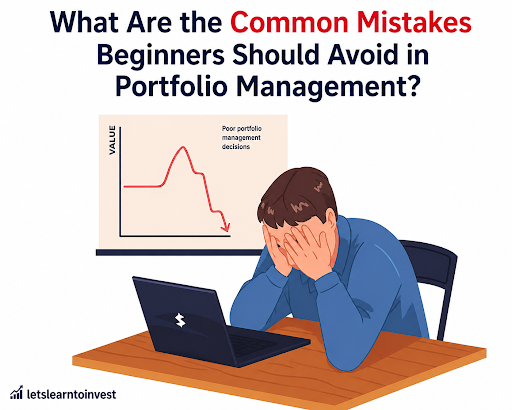
Many beginners enter the investment world with enthusiasm but often make mistakes that limit their long-term success. Fortunately, most of these mistakes can be avoided through education and disciplined investing.
One of the most common mistakes is investing without a clear financial goal. Without knowing why you are investing, it becomes difficult to choose the right investment strategy or measure success.
Another frequent mistake is concentrating all investments in a single stock, sector, or asset class. While this may produce high returns if everything goes well, it also exposes investors to unnecessary risks. Diversification remains one of the most effective ways to manage uncertainty.
Many investors also react emotionally to market fluctuations. During bull markets, they become overly optimistic and invest aggressively. During market corrections, fear often leads them to sell quality investments at lower prices. Emotional investing can significantly reduce long-term returns.
Ignoring portfolio reviews is another major error. Investments should be monitored regularly to ensure they continue supporting your financial objectives. Market conditions, personal circumstances, and economic environments change over time, making periodic reviews essential.
Finally, many beginners focus only on returns while ignoring investment costs, taxes, inflation, and risk. A successful portfolio is not simply the one with the highest returns but the one that consistently helps achieve long-term financial goals while managing risk effectively.
Final Thoughts
Portfolio management is not reserved for professional investors or individuals with large amounts of wealth. It is a practical financial skill that anyone can learn and apply. The journey toward financial freedom begins with understanding your goals, creating a diversified portfolio, allocating assets wisely, reviewing investments regularly, and staying disciplined through market ups and downs.
Remember that wealth creation is rarely the result of a single outstanding investment. Instead, it comes from making informed decisions consistently over many years. Markets will rise and fall, economic conditions will change, and investment trends will evolve, but a well-managed portfolio provides the foundation needed to navigate these changes confidently.
If you are just beginning your investment journey, start small, invest regularly, diversify your portfolio, and allow the power of compounding to work in your favor. Time in the market is often far more valuable than trying to perfectly time the market.
Frequently Asked Questions (FAQs)
Q1. What is portfolio management?
Portfolio management is the process of selecting and managing investments to achieve financial goals while controlling risk.
Q2. Why is diversification important?
Diversification reduces investment risk by spreading money across different asset classes and sectors.
Q3. How often should I review my portfolio?
Review your portfolio at least once a year or whenever your financial goals change.
Q4. Can beginners start portfolio management with a small investment?
Yes, beginners can start with small monthly SIPs and gradually build a diversified portfolio.
Q5. What is the biggest mistake in portfolio management?
The biggest mistake is investing without a plan and making emotional decisions during market fluctuations.
